

Diagnosing Developmental Language Disorder in Adults: Practical Tools and Considerations for SLPs
Written By:
Tatyana Elleseff, MA, CCC-SLP
Rutgers University


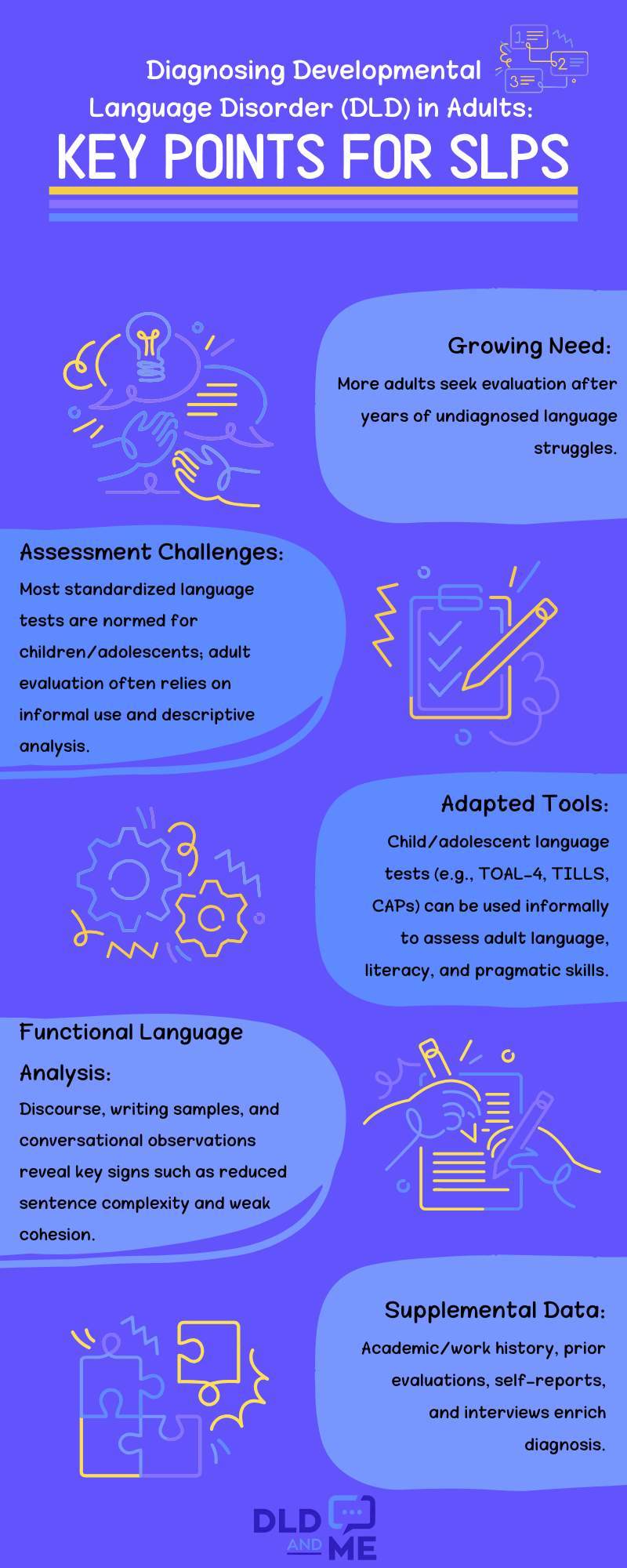
Downloadable Infographic
While much of the current research and clinical guidance on Developmental Language Disorder (DLD) focuses on children, a growing number of adults are seeking evaluations after years of undiagnosed communication struggles. As SLPs, many of us were trained to diagnose pediatric DLD but may feel less prepared to diagnose adults who present with this lifelong condition.
This brief guide provides an overview of tools and strategies that can support the diagnostic process when working with adults who self-identify or are referred for possible DLD.
General Considerations
Most standardized language assessments are normed for children or adolescents.
For adults, these tools are often used informally or descriptively to capture clinical patterns rather than generate standard scores.
In addition to formal measures, discourse analysis, writing samples, and functional communication observations often yield richer diagnostic data.
Standardized Tests Adaptable for Adult DLD Evaluation
While no test battery is fully normed for adults with DLD, the following measures can be useful for descriptive profiling:
TOAL-4 (Test of Adolescent and Adult Language – Fourth Edition) (Hammill et al, 2007)
Normed through age 24;11.
Can be used informally with older adults.
Assesses higher-level language skills, including word opposites, synonyms, and sentence combining.
Helpful for profiling syntactic and lexical weaknesses common in DLD.
TILLS (Test of Integrated Language and Literacy Skills) (Nelson et al, 2016)
Standardized for ages 6–18;11.
Recent research (Choi-Tucci et al., 2024) supports its utility for college-aged adults using adjusted cut scores.
Comprehensive measure across listening, speaking, reading, and writing domains.
A second edition with expanded adult norms is in development.
CAPs (Clinical Assessment of Pragmatics) (Lavi, 2019)
Normed through age 18; can be administered descriptively for adults.
Assesses pragmatic skills such as intention prediction, affective expression, and discourse comprehension.
Useful when pragmatic deficits are prominent in adult DLD profiles.
CELF-5 Metalinguistics (Wiig & Secord 2014).
Designed for ages 9–21.
Targets higher-level language processes (figurative language, multiple meanings, inference).
Can be administered informally for adults with suspected metalinguistic weaknesses.
GORT-5 (Gray Oral Reading Tests – Fifth Edition) (Wiederholt & Bryant, 2012)
Normed through age 23;11.
Assesses oral reading fluency, accuracy, rate, and comprehension.
Helpful for identifying reading-related language weaknesses often seen in adult DLD profiles.
Nelson-Denny Reading Test (Fishco, 2019)
Normed for ages 16–24.
Measures reading rate, vocabulary, and comprehension.
Can provide additional data on higher-level reading comprehension and processing speed when interpreted alongside other language measures.
Clinical Analysis of Discourse, Writing, and Functional Language Samples
In addition to standardized tools, functional discourse analysis is often critical for adult DLD evaluations. Consider:
Personal narratives or autobiographical retells
Academic writing samples (e.g., essays, summaries)
Expository or persuasive writing tasks
Functional conversations or problem-solving dialogues
Look for patterns such as:
Reduced sentence complexity
Lexical retrieval difficulties
Vague or disorganized expression
Weak cohesion and referential clarity
Inferencing or abstract language challenges
These qualitative markers often capture persistent DLD features more directly than formal scores.
Supplemental Data Sources
When possible, collect collateral data such as:
Academic history
Work performance reports
Prior learning disability evaluations
Self-report questionnaires (e.g., language questionnaires, social communication profiles)
Parent or partner interviews, when appropriate
This contextual information can help differentiate DLD from other neurodevelopmental or cognitive disorders that may present with overlapping features.
Practical Implications
Adult DLD is often under-identified, and many adults experience years of frustration before seeking answers. As SLPs, we are well positioned to provide both diagnosis and intervention. Even when normed adult tests are limited, a combination of flexible assessment tools, discourse analysis, and functional observations can yield powerful diagnostic insight and lead to life-changing support.
References1. Choi-Tucci, A., White, M., & Plante, E. (2024). Determining the diagnostic accuracy of the Test of Integrated Language and Literacy Skills for college students. American Journal of Speech-Language Pathology, 33, 1051–1058.
2. Fishco, V.V. (2019). Nelson-Denny Reading Test: Examiner’s Manual, Forms I and J.
3. Hammill, D. D., Brown, V. L., Larsen, S. C., & Wiederholt, J. L. (2007). Test of Adolescent and Adult Language, Fourth Edition. Austin, TX: PRO-ED.
4. Lavi, A. (2019). Clinical Assessment of Pragmatics (CAPs). WPS Publishing.
5. Nelson, N. W., Plante, E., Helm-Estabrooks, N., & Hotz, G. (2016). Test of Integrated Language and Literacy Skills (TILLS). Paul H. Brookes Publishing Co.
6. Wiederholt J. L., Bryant B. R. (2012a). Gray Oral Reading Tests (5th ed.). Austin, TX: Pro-Ed.
7. Wiig, E. H. & Secord, W. A. (2014). CELF-5 Clinical Evaluation of Language Fundamentals - Fifth Edition. Metalinguistics. Pearson.