

I Slipped Through the Cracks: A Guide for Adults with Developmental Language Disorder (DLD)
Written By:
Tatyana Elleseff, MA, CCC-SLP
Rutgers University


You Are Not Alone
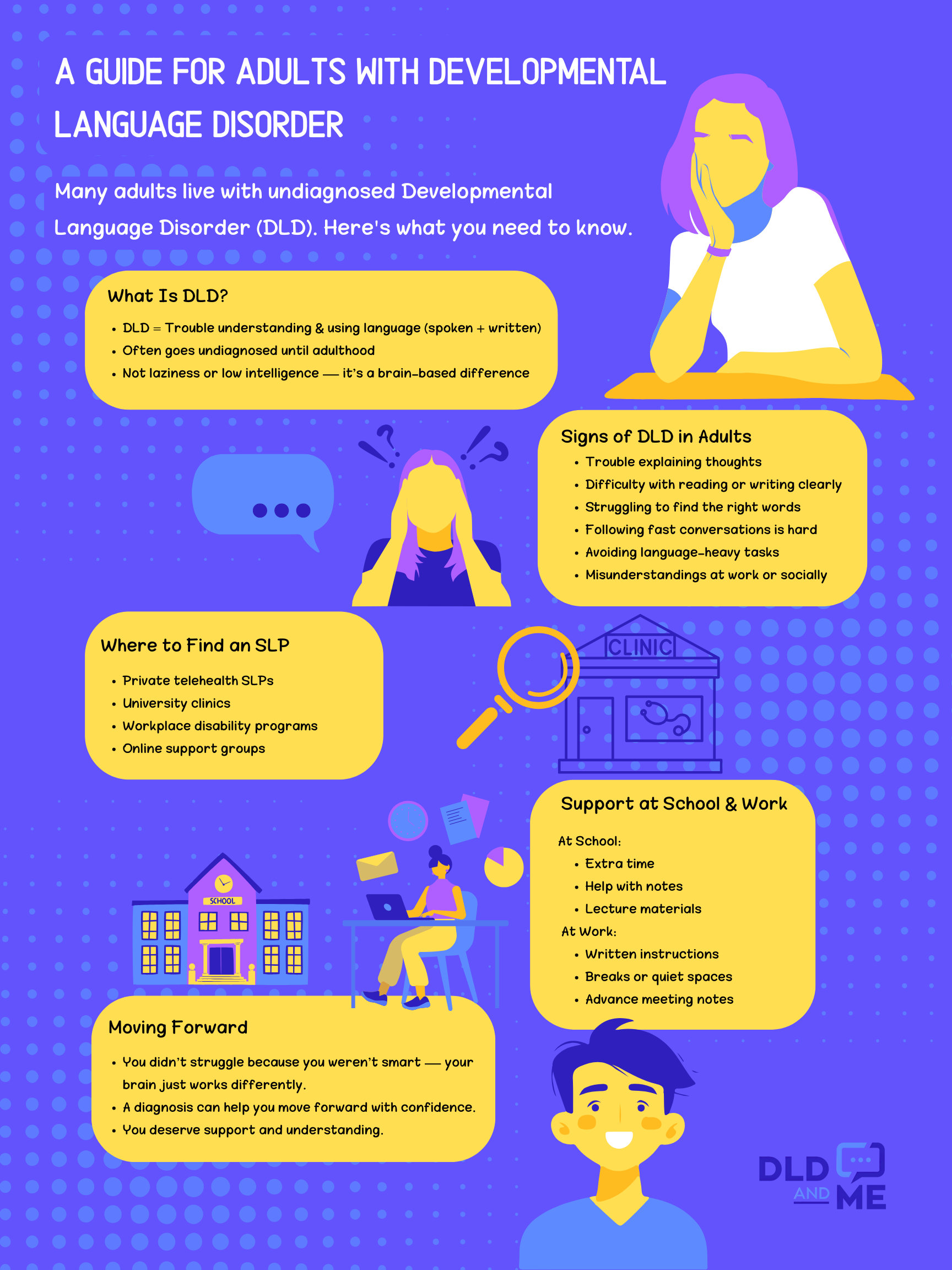
Downloadable Infographic
If you’ve always had trouble with communication — like finding the right words, keeping up with conversations, writing clearly, or explaining your thoughts — and you just learned about Developmental Language Disorder (DLD), you are not alone. Many adults with DLD were never diagnosed as children. Instead, they worked extra hard to keep up. Some were misunderstood or seen as not paying attention, being anxious, or not trying. These struggles often caused confusion, frustration, and a feeling of falling behind.
The good news: it’s never too late to understand what’s going on and find the help you need.
Signs of DLD in Adults
DLD makes it harder to understand and use both spoken and written language. Some signs include:
Trouble explaining your thoughts or ideas
Having a hard time following fast conversations or lectures
Problems understanding what you read or writing clearly
Struggling to find the right words or using simple words too often
Avoiding jobs or tasks that require lots of reading, writing, or talking
Having misunderstandings with friends or co-workers because of communication problems
Even if you’ve found ways to cope, these struggles can still affect your life. Noticing these patterns is the first step to understanding yourself better.
Getting Evaluated
A speech-language pathologist (SLP) can test your communication skills and help you figure out your strengths and challenges. Getting an evaluation as an adult might feel strange, especially if you’ve managed for years without one. But the goal isn’t to give you a label — it’s to help you make life easier.
Here are ways to find an SLP:
Search for private SLPs who work with adults (some offer teletherapy). Try ASHA’s ProFind (https://www.asha.org/profind/) or the American Board of Child Language and Language Disorders directory (https://www.childlanguagespecialist.org/consumers/). You can also search for “SLP for adult language disorders” or “SLP for developmental language disorder in adults.”
Contact university speech clinics, which may cost less.
Ask your employer if they offer help paying for evaluations through disability programs.
Check local hospitals or rehab centers for speech services.
Join online support groups for adults with DLD. Start by checking out the Connecting Adults with DLD Facebook Group (https://www.facebook.com/groups/connectingadultsdld/) or Reddit forum for learning disabilities like r/learningdisabilities.
What Happens During an Evaluation?
An SLP may give you some formal tests, but they will also watch how you use language in real life. They may:
Ask you to tell personal stories or explain ideas
Review your writing for organization and clarity
See how you follow directions or summarize information
Listen to how you talk during conversations
These real-life tasks often give the clearest picture of how DLD affects you.
Help at School and Work
In college, you might qualify for accommodations such as:
Extra time on tests and assignments
Help with taking notes
Written copies of lectures
Tutoring or writing center support
Early class registration
At work, the Americans with Disabilities Act (ADA) allows you to request support, like:
More time to read, write, or finish language-heavy tasks
Getting meeting notes in advance
Written instructions to go with verbal ones
Quiet spaces or short breaks to avoid feeling overwhelmed
Coaching or help with communication
You don’t have to tell everyone about your diagnosis, but you do have the right to ask for supports that help you succeed.
Moving Forward and Speaking Up
It can feel hard to speak up for yourself, especially after years of frustration or self-doubt. But knowing about DLD can help you see your past in a new way: you didn’t struggle because you weren’t smart or motivated — you struggled because your brain works differently.
Many adults with DLD blame themselves for bad grades, missed chances, or problems making friends. But these were not personal failures. They happened because of a language disorder that went unrecognized.
Getting a diagnosis is not only about services. It helps you understand yourself, build confidence, and find supports to help you reach your goals.
References
Americans with Disabilities Act of 1990, 42 U.S.C. § 12101 et seq. (1990).
Choi-Tucci, A., White, M., & Plante, E. (2024). Determining the diagnostic accuracy of the Test of Integrated Language and Literacy Skills for college students. American Journal of Speech-Language Pathology, 33, 1051–1058.
McGregor, K. K. (2020). How we fail children with developmental language disorder. Language, Speech, and Hearing Services in Schools, 51(4), 981–992.
Orrego, P. M., McGregor, K. K., & Reyes, S. M. (2023). A first-person account of developmental language disorder. American Journal of Speech-Language Pathology, 32(4), 1383–1396.
Wilmot, A., Boyes, M., Sievers, R., Leitão, S., & Norbury, C. (2024). Impact of developmental language disorders on mental health and well-being across the lifespan: A qualitative study including the perspectives of UK adults with DLD and Australian speech-language therapists. BMJ Open, 14(10), e087532.