
Thriving with DLD: How Therapy Helps Adults Build a Better Life
Written By:
Tatyana Elleseff, MA, CCC-SLP
Rutgers University



Downloadable Infographic
Getting a diagnosis of Developmental Language Disorder (DLD) as an adult can bring mixed emotions. On one hand, it can feel like a relief to finally understand why communication has always felt so hard. On the other hand, it may feel overwhelming to realize how many struggles were caused by something no one recognized for years. But here’s the good news: even if the diagnosis happens later in life, support and progress can still begin right now.
Using What You’ve Learned
Once adults learn how DLD has affected their communication, relationships, school or work experiences, and emotions, the next step is learning how to build skills for daily life. At this stage, therapy isn’t about “catching up” or fixing everything. Instead, it focuses on helping people build the tools they need to participate more fully in the world around them.
Speech-language pathologists (SLPs) play an important role. Instead of focusing only on vocabulary or grammar, effective therapy helps with real-world communication challenges: handling conversations at work, managing friendships, understanding jokes or sarcasm, writing emails, asking for help, and explaining ideas clearly. The goal is to help people function well in daily life—not to speak perfectly.
What Therapy for Adults with DLD Looks Like
1. Learning Practical Communication Skills
Therapy sessions are very personalized. The SLP works with each person’s unique goals, which may include:
Making messages clearer – Practicing how to explain, summarize, and ask questions to help others understand.
Reading between the lines – Learning how to recognize tone of voice, sarcasm, turn-taking, and when to speak or listen in group settings.
Handling overwhelm – Knowing when conversations or meetings are becoming too much, and learning how to ask for a break or clarification.
Dealing with difficult conversations – Practicing how to handle conflicts, set boundaries, or share personal information in both personal and work situations.
These skills are often practiced using role-plays, video feedback, and guided discussions. This gives clients a safe space to build confidence before using the skills in real life.
2. Getting Organized and Staying on Track
Many adults with DLD struggle with planning, organizing, or starting tasks. This isn’t due to laziness—it’s because language plays a big role in managing these skills, often called "executive functioning."
Therapy may include:
Using visual planners (like digital calendars or color-coded reminders)
Creating "Must-Do / Should-Do / Could-Do" lists to help prioritize tasks
Using scripts for problem-solving (such as: “What’s my next step?” or “What am I avoiding right now?”)
Learning time-blocking methods to schedule work and breaks
Practicing "bridging" strategies to help switch between tasks, especially when talking or writing is involved
Practice self-advocacy—learning what to say when asking for help or expressing needs
These aren’t one-size-fits-all productivity tips. They are tailored tools designed to lower stress and support independence.
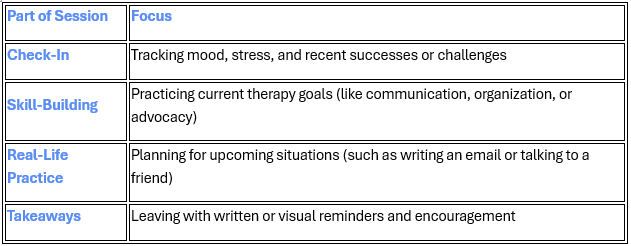
A Sample Weekly Therapy Plan
Keeping It Going Between Sessions
Therapy works best when it connects to real life. Many adults use:
Checklists for routines or social situations
Scripts and sentence starters for emails or conversations
Visual organizers to break big tasks into smaller steps
Mood trackers
Accountability buddies (trusted friends or mentors)
Redefining What Success Means
Therapy for adults with DLD isn’t about "fixing" language—it’s about gaining confidence and control. Real success means:
Asking for clarification without feeling embarrassed
Joining conversations without trying to hide confusion
Sharing ideas without fear of being misunderstood
Organizing your life in a way that works for you
Even small wins can have a big impact.
But it’s not only up to the person with DLD to make all the changes. Friends, family, teachers, coworkers, and the community also have an important role to play. When the people around you learn about DLD and understand how it affects communication, they can help create a more supportive environment. This might mean allowing extra time to process information, repeating information when needed, giving written notes and summaries after meetings, checking in to make sure instructions were clear, or simply being patient during conversations. Everyone communicates a little differently, and when both sides work together, conversations feel safer, easier, and less stressful. Thriving with DLD happens when people don’t have to hide their struggles—and when others make space for different communication needs.
You Are Not Too Late
Adults with DLD are not broken or beyond help. In fact, many have developed impressive problem-solving skills after years of figuring things out on their own. With the right support—delivered with respect, patience, and practical tools—adults with DLD can shift from simply coping to truly thriving.
If you see yourself in this article, please know: understanding your brain is not a weakness—it’s a strength. Seeking help is not about revisiting the past. It’s about building a better future, with confidence and purpose.
Finding Support:
If you’re looking for therapy, several resources can help you get started:
Find a Speech-Language Pathologist: Look for private SLPs who work with adults, including those who offer teletherapy. You can search ASHA’s ProFind or the American Board of Child Language and Language Disorders directory.
You can also search online using terms like “SLP for adult language disorders” or “SLP for developmental language disorder in adults.”
ReferencesDubois, P., St-Pierre, M.-C., Desmarais, C., & Guay, F. (2020). Young adults with developmental language disorder: A systematic review of education, employment, and independent living outcomes. Journal of Speech, Language, and Hearing Research, 63(11), 3786–3800.
McGregor, K. K., Arbisi-Kelm, T., Eden, N., & Oleson, J. (2020). The word learning profile of adults with developmental language disorder. Autism & Developmental Language Impairments, 5, 1–19.
Orrego, P. M., McGregor, K. K., & Reyes, S. M. (2023). A first-person account of developmental language disorder. American Journal of Speech-Language Pathology, 32(4), 1383–1396.
Rinaldi, S., Caselli, M. C., Cofelice, V., et al. (2021). Efficacy of the treatment of developmental language disorder: A systematic review. Brain Sciences, 11(3), 407.
Wilmot, A., Boyes, M., Sievers, R., Leitão, S., & Norbury, C. (2024). Impact of developmental language disorders on mental health and well-being across the lifespan: A qualitative study including the perspectives of UK adults with DLD and Australian speech-language therapists. BMJ Open, 14(10), e087532.