Written By:
Karla K. McGregor, Ph.D.
Boys Town National Research Hospital


Developmental Language Disorder (DLD) is a neurodevelopmental condition. Professionals diagnose some neurodevelopmental conditions by their symptoms, that is, by the problems that the person experiences.
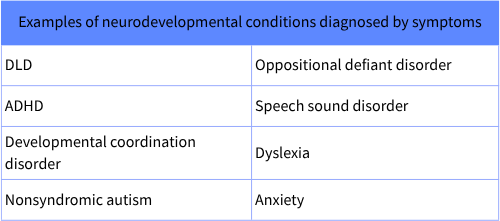
The tricky part of diagnosing these types of neurodevelopmental disorders is that they lack tidy boundaries. Their symptoms overlap. For example, an autistic child may also have difficulties with language. A child with DLD may also have attention difficulties. The symptoms overlap because these conditions have complex, overlapping causes and effects on brain development.
Misdiagnosis
Symptom overlaps do NOT necessarily mean that a person has more than one condition. However, overlapping symptoms make it difficult to diagnose a condition correctly. For example, children with ADHD and children with DLD often have difficulty following directions in the classroom. That one symptom does not allow us to tell one from the other. Careful evaluation is needed so that a child with DLD does not get mistakenly diagnosed as having ADHD, or vice versa.
Co-occurring diagnoses
Sometimes a person has symptoms that clearly indicate more than one condition. In those cases, both (or multiple) diagnoses are correct. For example, about 50% of children with DLD also have dyslexia. Compared to the general population, people with DLD are at higher risk of dyslexia, speech sound disorder, ADHD, dyscalculia (math disability), developmental coordination disorder, anxiety, and depression.
Diagnostic overshadowing
Diagnostic overshadowing happens when all symptoms are attributed to a single condition when really there is more than one. For example, a family might not seek an evaluation for DLD once their child has an ADHD diagnosis. They mistakenly think that the ADHD explains all of the child’s language and communication difficulties. Diagnostic overshadowing is a frequent problem. Ideally, a child with developmental concerns will be evaluated thoroughly so that all potential diagnoses can be ruled in or out and a comprehensive and appropriate support plan can be created.
The special case of causal conditions
Professionals sometimes have trouble determining whether autism or DLD is the correct diagnosis. That is because either condition can affect language, communication, and social interaction. Sometimes a person clearly has autism but also signs of significant language disorder. In those cases, most professionals do not use the term DLD. Instead, they say that the child has a language disorder associated with autism.
In fact, when the child has any biomedical condition that is known to cause language challenges, professionals avoid the term DLD. Instead, they use the ‘associated with’ phrase. Here are some examples:
Language disorder associated with autism
Language disorder associated with hearing loss
Language disorder associated with head injury
Language disorder associated with Down Syndrome
Language disorder associated with intellectual disability
When a person has DLD and another condition, but that second condition does not cause language challenges, the DLD term applies. Here are some examples:
DLD and anxiety
DLD and ADHD
DLD and speech sound disorder
DLD and developmental coordination disorder
DLD and dyslexia
Important takeaways
Some people have DLD only, although their difficulties often extend beyond language.
For example, they may also be clumsy, but not so clumsy that they are diagnosed with developmental coordination disorder.
They may also have attention lapses, but not so much that they are diagnosed with ADHD.
Careful differential diagnosis will ensure that these other symptoms do not lead to misdiagnosis.
The risk of misdiagnosis is that the person will not receive the correct intervention.
Some people with DLD also have other neurodevelopmental conditions.
Comprehensive evaluation will ensure that these co-occurring conditions are identified but do not overshadow DLD.
The risk of diagnostic overshadowing is that the person will not receive the complete range of interventions they require.
Some people have conditions that are known to cause language impairment.
We refer to these cases as “language disorder associated with X”.
Just like DLD, these significant language challenges should be identified and treated.
References:Bishop, D. V., Snowling, M. J., Thompson, P. A., Greenhalgh, T., Catalise‐2 Consortium, Adams, C., ... & House, A. (2017). Phase 2 of CATALISE: A multinational and multidisciplinary Delphi consensus study of problems with language development: Terminology. Journal of child psychology and psychiatry, 58(10), 1068-1080. https://doi.org/10.1111/jcpp.12721Digital Object Identifier (DOI)
McGregor, K. K., Goffman, L., Plante, E., & Werfel, K. (2025). Developmental language disorder as a multidimensional neurodevelopmental spectrum: Implications for diagnosis. Journal of Speech, Language, and Hearing Research, 68(12), 6069-6088. https://doi.org/10.1044/2025_JSLHR-25-00089